
A new policing command bringing together Greater Manchester Police and transport authorities has been launched, with plans to increase visible patrols and tackle crime and antisocial behaviour across the Bee Network.
The launch of The Transport Policing and Crime Command (TPACC) will see Greater Manchester Police team up with Transport for Greater Manchester and the Greater Manchester Combined Authority to improve how crime, antisocial behaviour and road safety issues are tackled across the region. Led by Chief Superintendent Suzanne Downey, the command with effectively operate as Greater Manchester Police’s 11th policing district, with more than 60 new officers expected to work across the network supported by existing transport safety teams and TfGM staff.
The initiative has been funded through the mayoral budget, with the aim of increasing police visibility without diverting existing GMP frontline resources. Mayor of Greater Manchester Bev Craig said the new command would bring resources together to strengthen patrols across the Bee Network and the region’s roads.
“One of the things that people have told me time and time again, is they want to see more police on the streets, they want to see us tackle antisocial behaviour, and they want to feel safe in their areas.”, Bev told me, “For me, we’ve taken a brand new approach to this, not just some additional police officers, but a brand new police and district, integrated command and control that lets our transport system work with the police.”
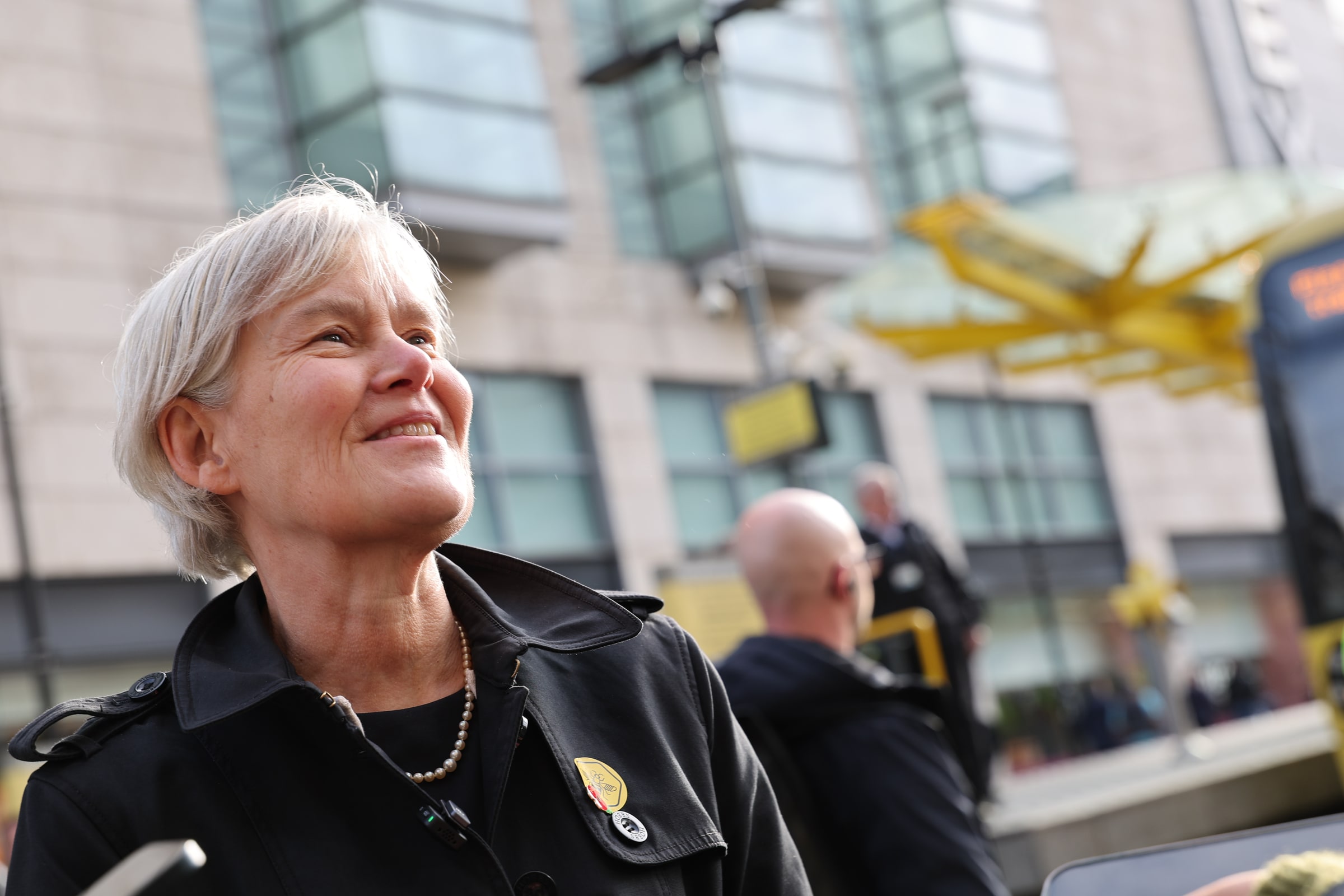
Deputy Mayor of Greater Manchester Kate Green told me her hope was to see an increased feeling of safety across the network, particularly for women and girls travelling after dark.
Office of National Statistics and Department for Transport data shows that nearly half of women feel “very or fairly unsafe” using public transport alone after dark, compared to just under one-fifth of men in the same situation. In fact, Women in Transport figures reflect that around 63% of women avoid evening travel altogether. They recognised that women associate safe travel with four key elements of their journey:
- Being able to travel free from harassment
- Having their personal space respected
- Being able to see visible staff who can help
- Their journeys being well-lit.
I heard from three women in Manchester who have experienced an unsafe journey on the Bee Network in the last year and asked them about the resources they felt they had available to them in the moment.
19-year-old Ellis from Oldham
“I was on a tram on the way to see my then-boyfriend in town and I was just checking my makeup in my phone camera and sitting minding my own business when an older man and a woman who were clearly inebriated started saying the most random but nasty stuff to me, just berating me. They were swearing at me and calling me a slag. What I found most shocking is me, a young girl sat on my own on a tram being harassed by these older intoxicated people, was that nobody said anything or intervened. This is a bust tram into Manchester and was very full of men and women of all ages and they did absolutely nothing. I definitely didn’t feel like there was any sort of help or resources.”
20-year-old Ava living in Salford
“I was travelling home on a Bee Network bus, a man had been following two women from work, they were nurses and they were brown – he was white. He had racist motives and was hurling abuse at them telling them they didn’t belong in the country and things like that. When the bus driver stopped the bus to remove him, he noticed that the driver was Irish and started hurling abuse at him as well. He was spitting at him through the holes in the door between them and eventually got the door open and was spitting directly at him. Every time the driver managed to get him off, he would hit the emergency OPEN DOOR button and get back on the bus, yelling “If I’m not on the bus you’re not going anywhere”. Eventually, a man from the top deck came down and intimidated the racist man until he got off.”
“In the moment I noted down the bus number, but I was too scared to call the police as the man was being racist towards Irish people, and I have an Irish accent and I would have been spat at or abused. I reported it later, but as the two women didn’t come forwards, and neither did the driver, there was nothing they could do.”
22-year-old Hannah living in Chorlton
“I was on the 36 from the crown court with a man who seemed to be on drugs. The man was getting in everyone’s face and shouting that they were ‘braindead idiots’ if they were on their phone. He was aggressively shouting and I was very intimidated by him because it was clear he wasn’t sound of mind and had taken something. I was scared so I just kept my head down and didn’t want to cause a fuss. I didn’t say anything to the driver because I didn’t know what he’d be able to do anyway, and I was just trying to avoid escalating anything so I just kept my head down.”
The launch of TPACC follows a series of attempts to improve safety on transport across Greater Manchester, notably last years launch of the TravelSafe Live Chat. TravelSafe allows passengers to discreetly report non-emergency crime, antisocial behaviour or safety concerns on Bee Network buses, trams and at interchanges. It is designed for situations where speaking out loud on a phone call could draw unwanted attention or put you at risk and is manned by human handlers. You connect within seconds to a real person from a trained Greater Manchester Police team rather than a chatbot.
However, despite the Bee Network recording over 60 million journeys for more than 1.1million unique customers annually, TravelSafe Live Chat has been used by just over 2,000 passengers. Just 13% of the chats received have been escalated to receive an immediate emergency response. The young women I spoke to were not aware of the TravelSafe service.
Ellis told me, “I didn’t feel like I had access to any sort of help. I feel like in situations where you’re being harassed, I’ve never heard of anything you can call or anyone you can speak to.”
Deputy Mayor Kate Green told me, “We have very, very few incidents. I think its one in every 45 million journeys, but if people don’t feel safe, they’re not going to use the network. We launched TravelSafe Live Chat a year ago to make it easier for people to report and get in touch with GMP. Now we want more officers visibly on the network to provide that reassurance.”
Chief Constable Sir Stephen Watson hopes that the new Transport Policing and Crime Command will do just that: build on existing efforts to not just make the Bee Network safe, but make it feel safe for everyone with more visible officer presence, and increased revenues that are able to be put back into transport safety.
Sir Watson told me, “We have qualitative evidence to suggest that, particularly women and girls, into the evening, frequently find our moving infrastructure to be a little threatening, and they choose not to use the infrastructure as a result. If people feel unsafe, that must be a red line for us all. We’re determined to nut into that and we do it in a way that causes more people to use our system. More people using the system, more people paying their way, more revenues from those revenues. We grow our capacity to do it.”
As TPACC begins to gain traction across Greater Manchester, the hope is that everyone, women and girls included, will one day soon be able to take a safe journey on the Bee Network with no fear of violence or harassment.