

Paige Edge, 18, started taking a combined oral contraceptive pill in April and started suffering from headaches in September.
Melissa Thackeray, Paige’s mother, told the Manchester Evening News, “A few weeks before she passed, she said to me she had a bit of a headache, but it wasn’t a serious headache, and she just said she had a migraine, so we gave her paracetamol.”
On the 28th of September, while staying at a family member’s house, Paige was found unresponsive, with two family members trying to do CPR on her.
After being rushed to the hospital, Paige was placed in an induced coma for eight days, during which doctors discovered a large blood clot in her brain as well as multiple smaller ones.
Melissa was reportedly told by doctors that the blood clots were likely caused by the combined oral contraceptive pill.
Sadly, before doctors had a chance to operate, Paige was declared brain dead, and the decision was made to turn off her life support machine on the 6th of October.

Credit- Facebook, Melissa Thackeray
Love poured out on social media in memory of Paige.
One said, “Words can’t describe how sad I am to hear this, absolutely heartbroken, such a lovely young girl gone way too soon, thinking of you all”.
Melissa Thackeray is now determined to raise awareness of the possible side effects of the pill.
She said, ” You don’t sit there and read the leaflet for two hours about the side effects.”
This should be on red ink on the box ‘This can cause blood clots’. As a mum, you wouldn’t think that something that’s out there that a doctor supplies could cause this after six months of her taking it.”
A survey by University College London and the London School of Hygiene and Tropical Medicine estimated that 76% of women of reproductive age in the UK, as well as an unknown number of trans men and non-binary people, were using contraception at any one time in 2010.
There are several different types of oral contraception available, including combined. These contain a combination of two hormones—oestrogen and progestogen, and POPs, progestogen only pills.
Faith Verity, a student at Salford University, takes Desogestrel (a progestogen-only pill), and told Quays News that her box of Desogestrel, which was easily prescribed to her by a doctor, does not mention any possible side effects on the box; instead, it only mentions a few possible side effects towards the end of a double-sided A4 leaflet.
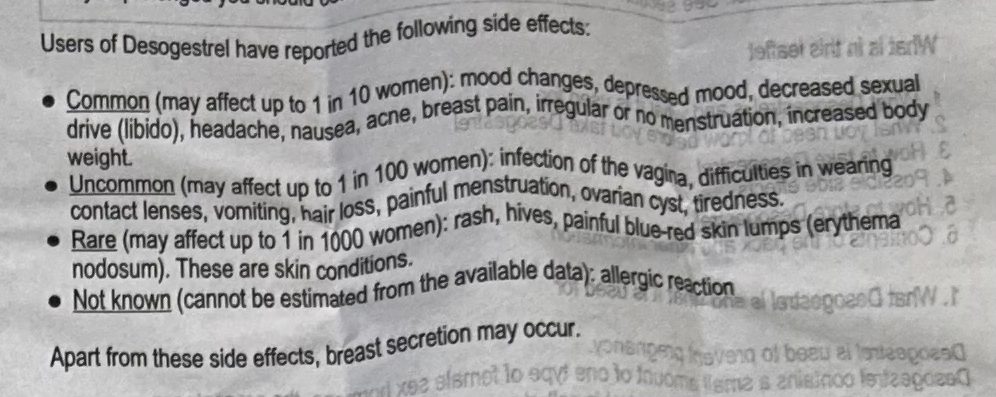
These side effects included “common” side effects: depressed mood, decreased libido and headaches to name a few.
Some “Uncommon” side effects include: infection of the vagina, difficulties in wearing contact lenses, hair loss.
There are also three “rare” side effects listed in the leaflet: rashes, hives and painful blue-red skin lumps.
It is not just the pill form of birth control that can cause side effects.
Hope Karim, a 21-year-old from Salford, used to have the Depo-Provera injection.
The Depo-Provera injection is an injectable progestin-only hormonal birth control method given every 12 to 13 weeks to prevent pregnancy.
Karim described how the injection made her, “Have a one-month period at the start and then no period at all”.
An irregular period is one of the possible side effects of the injection.
Karim went on to say ” After this I started developing anxiety as it changed the way my body dealt with stress, I didn’t get told this could be a potential side effect, wasn’t told any side effects really”.
Anxiety is not listed in the possible side effects of taking the Depo-Provera injection.
The active hormone and its effects can take up to 12 months to leave your system.
“After I stopped taking it I still felt the anxiety in my system as I didn’t get told that it takes up to a year for it to completely leave my system… I was menstruating for multiple weeks at a time, or none at all.”
Karim believes “Hormonal contraception is under-researched, and medical providers who offer it don’t offer the correct education for the person seeking out the contraception.”
A survey answered by 296 clinicians, with 80% being in paediatrics, found that, “Most clinicians strongly or somewhat agreed that they were up to date with current literature regarding contraception (15% and 52%, respectively). The majority strongly or somewhat agreed that it is their responsibility to ask patients about their need for birth control, are confident in their abilities to provide a range of options and will provide birth control to their adolescent patients even if parents disapprove.
The NHS estimates that around 1 in 1000 people on a combined contraceptive pill will experience a blood clot.
They also add that a doctor, nurse or pharmacist will check if you have certain risk factors before prescribing the pill.
A spokesperson for NHS Greater Manchester said, “Safe prescribing requires patients to be appropriately assessed and given clear information about the benefits and potential risks of their medication.
“The contraceptive pill is a safe and effective method of contraception for many people, although there are potential risks and side effects.”
“People should be given appropriate information about these, including the signs of a possible blood clot and when to seek medical advice.
“We take any medicine safety concerns extremely seriously and will consider whether there is any learning that should be shared with healthcare professionals across Greater Manchester.”