

Alan Milburn. Image: gov.uk
National Insurance (NI) paid on under-25s in the workplace is set to be lowered to encourage more young people to seek a job, according to an upcoming report.
An interim report conducted by the government’s Department for Work & Pensions, will say close to a million people aged 16 to 24 in The United Kingdom are not in education, employment, or training. Often called NEETs, they account for one in eight young people.
The government department said that “behind the statistics lie individual lives: aspirations thwarted, opportunities lost, futures placed on hold.”
The percentage of 16–24-year-olds in the UK that are not in education, employment or training, NEET, by quarter, from 2019 to 2026.
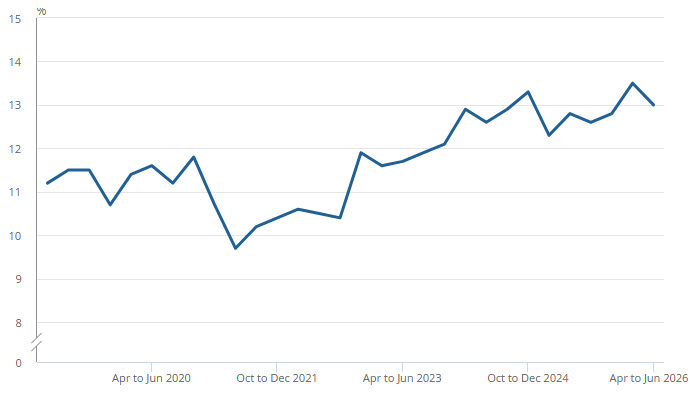
Infographic: Office of National Statistics
The report states that the scheme will begin with hospitality and retail firms, of which provides nearly 40% of jobs to the age group.
Former Labour minister Alan Milburn’s year-long review is expected to act as a radical overhaul of the welfare system and would lead to the cut of other financial support.
The rest of the report is set to be released today (Tuesday) by Milburn, and has already announced his proposals such as:
– A legal guarantee of a job, training or support with employment with those who refuse to take up potentially losing their benefits.
– Reducing benefits, under-25s no longer being able to claim Universal Health Credit or personal independence payments (PiP); the main payment for disabilities in in England and Wales; these being replaced with a “youth allowance”.
– Doubling the threshold where businesses pay NI for 21–24-year-olds from £5,000 to £10,000.
Currently, businesses pay zero employer NI contributions for workers under 21 and apprentices under 25, unless earning over £50,270. For non-apprentices however, employers pay 15% on annual earning above £5,000.
Work and Pensions Secretary Pat McFadden has refused to rule out some young people losing benefits and told the BBC that job support should be given a “legislative underpinning”, calling the current government assistance on helping young people find employment “vague”. It is not clear whether McFadden supports the proposal of cutting universal credit or PiP.

Andy Burnham. Image: gov.uk
The Prime Minister Andy Burnham, writing in The Guardian, calls for a “generational response”: “the way I see it we have two choices: we can either invest in our young people and give them a proper chance to get on; or we can continue to pay the price for failure. I choose the first”.
National Insurance is a tax on earnings that is paid by both employees (from their wages) and by employers (on top of the wages they pay out), as well as by the self-employed (from their trading profits).